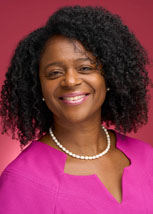
For voters in the 28th Senate District, Lola Smallwood-Cuevas came to Sacramento from the labor institutions of Los Angeles. Before her election to the California State Senate in 2022, she worked at the UCLA Labor Center, founded organizations focused on Black employment and racial equity, and spent more than two decades as a labor organizer, civil rights activist and community advocate. Her most concrete work connected working-class Black residents with jobs, construction training and union resources. She also pressed government contractors to hire locally and spoke against city policies on policing and homelessness. Smallwood-Cuevas succeeded Sydney Kamlager-Dove, who left the Senate after her election to California’s 37th congressional district seat.
THE JOB BEFORE THE JOB
Smallwood-Cuevas was raised by a single mother who worked as a registered nurse and homecare worker. Her own professional record is concentrated in labor organizing and civil rights work. She was at the UCLA Labor Center from 2004 to 2022, serving as its project director for 15 years.
At UCLA, she founded the Los Angeles Black Worker Center, whose mission is to connect working-class Black residents of Los Angeles with employment prospects and unionization resources. She also founded the Center for the Advancement for Racial Equity at Work.
The Black Worker Center did more than make a case for access to construction jobs. By 2015, it had become instrumental in training Black residents to enter the construction industry. It advocated for government contractors to prioritize local hiring. Those efforts led to Black residents making up 20% of the Metro Crenshaw K Line project workforce. In October 2015, President Barack Obama recognized the center’s success. It was national recognition for an operation rooted in the practical local machinery of training, contracting and hiring.
THE PATH TO OFFICE
Smallwood-Cuevas entered the Senate after years of organizing outside elected government, but her public work already involved government decisions and their consequences. In July 2020, she spoke against Los Angeles Mayor Eric Garcetti’s announced expansion of policing in communities of color. She also criticized the Los Angeles City Council’s vote to resume cleaning encampments in special zones.
She called the policing expansion and encampment cleanings “regressive thinking that we need to move beyond.” Her argument joined the two policies to the city’s racial disparities in homelessness: Black residents, she said, were 7% of the population but 40% of those on the street.
That intervention placed her in a familiar position from her labor work: addressing a city policy by identifying which residents would bear its effects. Two years later, voters elected her to represent the 28th Senate District. The opening came when Kamlager-Dove vacated the seat after winning election to Congress. Smallwood-Cuevas moved into state office with a record centered on labor, Black employment and policies affecting marginalized communities.
THE POLICY SIGNATURE
Smallwood-Cuevas is most closely identified with the employment interests of working-class Black residents and with the institutional means of expanding their access to work. The Black Worker Center’s method was specific: connect residents to job prospects and unionization resources, provide construction training, and press government contractors to prioritize local hires. The Metro Crenshaw K Line workforce numbers supplied the measurable result.
Her broader record extends to racial equity at work, through the second center she founded, and to city policies affecting communities of color and people living on the street. In the documented work preceding her Senate service, she used labor organizations, training programs and government contracting advocacy as the working parts of policy.
There is no need to search for an abstract theme. The through line is in the constituencies and the mechanisms she has repeatedly chosen: working-class Black residents, marginalized communities, access to employment, union resources, local hiring and scrutiny of government action. That is the public record Smallwood-Cuevas carried from the UCLA Labor Center into the California Senate.
- State Senate · Senate District 28 · 2022–present
For voters in the 28th Senate District, Lola Smallwood-Cuevas came to Sacramento from the labor institutions of Los Angeles. Before her election to the California State Senate in 2022, she worked at the UCLA Labor Center, founded organizations focused on Black employment and racial equity, and spent more than two decades as a labor organizer, civil rights activist and community advocate. Her most concrete work connected working-class Black residents with jobs, construction training and union resources. She also pressed government contractors to hire locally and spoke against city policies on policing and homelessness. Smallwood-Cuevas succeeded Sydney Kamlager-Dove, who left the Senate after her election to California’s 37th congressional district seat.
THE JOB BEFORE THE JOB
Smallwood-Cuevas was raised by a single mother who worked as a registered nurse and homecare worker. Her own professional record is concentrated in labor organizing and civil rights work. She was at the UCLA Labor Center from 2004 to 2022, serving as its project director for 15 years.
At UCLA, she founded the Los Angeles Black Worker Center, whose mission is to connect working-class Black residents of Los Angeles with employment prospects and unionization resources. She also founded the Center for the Advancement for Racial Equity at Work.
The Black Worker Center did more than make a case for access to construction jobs. By 2015, it had become instrumental in training Black residents to enter the construction industry. It advocated for government contractors to prioritize local hiring. Those efforts led to Black residents making up 20% of the Metro Crenshaw K Line project workforce. In October 2015, President Barack Obama recognized the center’s success. It was national recognition for an operation rooted in the practical local machinery of training, contracting and hiring.
THE PATH TO OFFICE
Smallwood-Cuevas entered the Senate after years of organizing outside elected government, but her public work already involved government decisions and their consequences. In July 2020, she spoke against Los Angeles Mayor Eric Garcetti’s announced expansion of policing in communities of color. She also criticized the Los Angeles City Council’s vote to resume cleaning encampments in special zones.
She called the policing expansion and encampment cleanings “regressive thinking that we need to move beyond.” Her argument joined the two policies to the city’s racial disparities in homelessness: Black residents, she said, were 7% of the population but 40% of those on the street.
That intervention placed her in a familiar position from her labor work: addressing a city policy by identifying which residents would bear its effects. Two years later, voters elected her to represent the 28th Senate District. The opening came when Kamlager-Dove vacated the seat after winning election to Congress. Smallwood-Cuevas moved into state office with a record centered on labor, Black employment and policies affecting marginalized communities.
THE POLICY SIGNATURE
Smallwood-Cuevas is most closely identified with the employment interests of working-class Black residents and with the institutional means of expanding their access to work. The Black Worker Center’s method was specific: connect residents to job prospects and unionization resources, provide construction training, and press government contractors to prioritize local hires. The Metro Crenshaw K Line workforce numbers supplied the measurable result.
Her broader record extends to racial equity at work, through the second center she founded, and to city policies affecting communities of color and people living on the street. In the documented work preceding her Senate service, she used labor organizations, training programs and government contracting advocacy as the working parts of policy.
There is no need to search for an abstract theme. The through line is in the constituencies and the mechanisms she has repeatedly chosen: working-class Black residents, marginalized communities, access to employment, union resources, local hiring and scrutiny of government action. That is the public record Smallwood-Cuevas carried from the UCLA Labor Center into the California Senate.
The record
4,633 events, each with its sourceAssembly 3rd Reading AB1707 Davies By Smallwood-Cuevas
Assembly 3rd Reading AB1729 Lee et al. By Ashby Urgency Clause
Assembly 3rd Reading AB1741 Pacheco By Rubio
Assembly 3rd Reading AB1741 Pacheco By Rubio Reconsider
Assembly 3rd Reading AB1741 Pacheco By Rubio
Assembly 3rd Reading AB1755 Sharp-Collins et al. By Rubio
Assembly 3rd Reading AB1769 Ramos et al. By Cervantes
Assembly 3rd Reading AB1798 Wilson et al. By Padilla
Assembly 3rd Reading AB1798 Wilson et al. By Padilla Reconsider
Assembly 3rd Reading AB1798 Wilson et al. By Padilla
Special Consent AB1832 Ransom et al. By Umberg
Special Consent AB1844 Pacheco By Laird
Assembly 3rd Reading AB1845 Krell et al. By Pérez
Special Consent AB1846 Stefani By Wahab
Assembly 3rd Reading AB1891 Connolly et al. By Becker
Assembly 3rd Reading AB1897 Haney By Wiener
Assembly 3rd Reading AB1902 Pellerin By Laird
Assembly 3rd Reading AB1902 Pellerin By Laird Reconsider
Assembly 3rd Reading AB1902 Pellerin By Laird
Special Consent AB1904 Gipson et al. By Smallwood-Cuevas
Assembly 3rd Reading AB1906 Aguiar-Curry By Pérez
Special Consent AB1907 Addis et al. By Durazo
Assembly 3rd Reading AB1940 Calderon et al. By Gonzalez
Assembly 3rd Reading AB1967 Zbur By Laird
Special Consent AB1985 Irwin et al. By Stern
Special Consent AB1996 Bonta et al. By Ashby
Assembly 3rd Reading AB2009 Chen et al. By Blakespear
Assembly 3rd Reading AB2012 Hoover et al. By Grayson
Assembly 3rd Reading AB2015 Wicks By Arreguín
Assembly 3rd Reading AB2028 Chen By Choi
Assembly 3rd Reading AB2035 Dixon By Choi
Assembly 3rd Reading AB2051 Wicks et al. By Pérez
Special Consent AB2055 Jeff Gonzalez By Seyarto
Assembly 3rd Reading AB2058 Harabedian et al. By Arreguín
Assembly 3rd Reading AB2080 Johnson By Choi
Special Consent AB2081 Stefani et al
Assembly 3rd Reading AB2167 Macedo By Niello
Assembly 3rd Reading AB2207 Hadwick By Umberg
Assembly 3rd Reading AB2212 Bauer-Kahan et al. By Cervantes
Assembly 3rd Reading AB2227 Connolly et al. By Pérez
Assembly 3rd Reading AB2231 Ahrens By Arreguín
Assembly 3rd Reading AB2244 Gabriel et al. By Weber Pierson
Assembly 3rd Reading AB2246 Wicks et al. By Padilla
Assembly 3rd Reading AB2266 Schultz By Becker
Assembly 3rd Reading AB2294 Ta et al. By Umberg
Assembly 3rd Reading AB2294 Ta et al. By Umberg Reconsider
Assembly 3rd Reading AB2298 Irwin By Hurtado
Assembly 3rd Reading AB2313 Berman et al. By Ashby
Assembly 3rd Reading AB2318 Elhawary et al. By Gonzalez
Special Consent AB2326 AGRI. (Soria) By Caballero