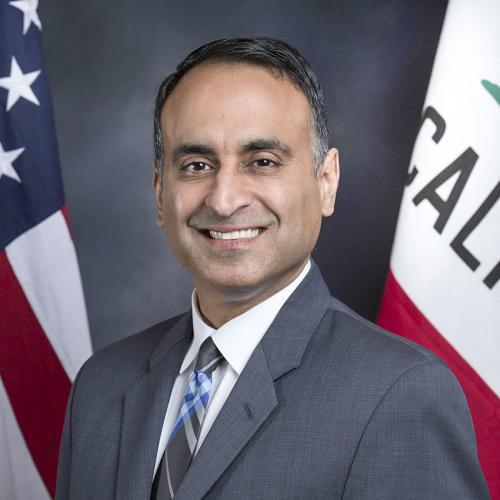
Oak Grove High School, the Santa Clara County public defender’s office, the San Jose City Council and the State Assembly mark Ash Kalra’s route through public life. Born in Toronto to Punjabi parents from India, he came to the United States with his family in 1978 and settled in San Jose, where he has lived ever since. He taught law and spent 11 years representing people charged with felonies and misdemeanors, much of that time in drug treatment court. He won a South San Jose council seat in 2008 and moved to the Assembly in 2016. Today, he holds three positions that locate him within the Legislature: chair of the progressive caucus, chair of the labor committee and chair of a select committee devoted to the future of work and workers.
ROOTS
Kalra attended San Jose public schools and graduated from Oak Grove High School. He earned a bachelor’s degree in communications from the University of California, Santa Barbara, in 1993, followed by a law degree from Georgetown University in 1996. While studying law, he taught at inner-city schools in Washington, D.C.
His life since his family’s arrival in 1978 has remained centered in San Jose. He later taught law at San Jose State University and Lincoln Law School, worked for Santa Clara County and represented South San Jose on the City Council. Kalra practices Hinduism and is vegan. His 2016 election made him the first Hindu and Indian American to serve in the California State Legislature.
THE JOB BEFORE THE JOB
Kalra’s work as a deputy public defender lasted 11 years. He handled felony and misdemeanor trials, but spent most of his time in drug treatment court, helping clients enter rehabilitation programs. That work placed him inside a part of county government where criminal cases, treatment programs and individual lives meet.
He also worked as a law professor at San Jose State University and Lincoln Law School. His work combined courtroom representation as a Santa Clara County deputy public defender with legal instruction at San Jose State University and Lincoln Law School.
Kalra entered elected office in 2008, winning the District 2 seat on the San Jose City Council. The district encompassed South San Jose, and he served two terms. In 2011, while on the council, he was arrested for driving under the influence of alcohol and pleaded no contest. He was sentenced to community service and counseling.
THE PATH TO THE ASSEMBLY
In 2016, Kalra ran for the State Assembly seat held by term-limited Democrat Nora Campos. He defeated fellow Democrat and San Jose councilmember Madison Nguyen and was first elected to the Assembly in 2016.
His institutional position now runs through the Legislature’s progressive and labor ranks. He chairs the California Legislative Progressive Caucus, the Assembly Labor and Employment Committee and the Assembly Select Committee on the Future of Work and Workers. Those posts give him formal roles in organizing progressive legislators and overseeing committees concerned with employment and changes in work.
Kalra supported Bernie Sanders’s 2020 presidential campaign. When Xavier Becerra left the California attorney general’s office, Kalra was mentioned as a possible replacement; Rob Bonta received the appointment instead. The episode did not change Kalra’s office, but it placed his name in consideration for a statewide law-enforcement position.
THE POLICY SIGNATURE
Kalra authored the California Racial Justice Act of 2020. That work followed an earlier public record spent representing criminal defendants, including clients seeking entry into rehabilitation programs.
His committee assignments put workers and employment within his formal reach. He chairs both the standing Assembly committee on labor and employment and the select committee on the future of work and workers, while also leading the progressive caucus.
A 2023 bill showed another side of his approach to government enforcement. Kalra authored legislation that would prohibit towing or immobilizing vehicles because of unpaid parking tickets. The proposal would remove two consequences faced by vehicle owners with outstanding tickets. It also drew a direct objection: a San Jose Department of Transportation spokesperson said the bill would make parking enforcement in the city more difficult. Taken together, Kalra’s documented work centers on criminal defendants, people directed toward rehabilitation, workers and motorists facing penalties over unpaid tickets.
- State Assembly · Assembly District 27 · former
- State Assembly · Assembly District 25 · 2022–present
Oak Grove High School, the Santa Clara County public defender’s office, the San Jose City Council and the State Assembly mark Ash Kalra’s route through public life. Born in Toronto to Punjabi parents from India, he came to the United States with his family in 1978 and settled in San Jose, where he has lived ever since. He taught law and spent 11 years representing people charged with felonies and misdemeanors, much of that time in drug treatment court. He won a South San Jose council seat in 2008 and moved to the Assembly in 2016. Today, he holds three positions that locate him within the Legislature: chair of the progressive caucus, chair of the labor committee and chair of a select committee devoted to the future of work and workers.
ROOTS
Kalra attended San Jose public schools and graduated from Oak Grove High School. He earned a bachelor’s degree in communications from the University of California, Santa Barbara, in 1993, followed by a law degree from Georgetown University in 1996. While studying law, he taught at inner-city schools in Washington, D.C.
His life since his family’s arrival in 1978 has remained centered in San Jose. He later taught law at San Jose State University and Lincoln Law School, worked for Santa Clara County and represented South San Jose on the City Council. Kalra practices Hinduism and is vegan. His 2016 election made him the first Hindu and Indian American to serve in the California State Legislature.
THE JOB BEFORE THE JOB
Kalra’s work as a deputy public defender lasted 11 years. He handled felony and misdemeanor trials, but spent most of his time in drug treatment court, helping clients enter rehabilitation programs. That work placed him inside a part of county government where criminal cases, treatment programs and individual lives meet.
He also worked as a law professor at San Jose State University and Lincoln Law School. His work combined courtroom representation as a Santa Clara County deputy public defender with legal instruction at San Jose State University and Lincoln Law School.
Kalra entered elected office in 2008, winning the District 2 seat on the San Jose City Council. The district encompassed South San Jose, and he served two terms. In 2011, while on the council, he was arrested for driving under the influence of alcohol and pleaded no contest. He was sentenced to community service and counseling.
THE PATH TO THE ASSEMBLY
In 2016, Kalra ran for the State Assembly seat held by term-limited Democrat Nora Campos. He defeated fellow Democrat and San Jose councilmember Madison Nguyen and was first elected to the Assembly in 2016.
His institutional position now runs through the Legislature’s progressive and labor ranks. He chairs the California Legislative Progressive Caucus, the Assembly Labor and Employment Committee and the Assembly Select Committee on the Future of Work and Workers. Those posts give him formal roles in organizing progressive legislators and overseeing committees concerned with employment and changes in work.
Kalra supported Bernie Sanders’s 2020 presidential campaign. When Xavier Becerra left the California attorney general’s office, Kalra was mentioned as a possible replacement; Rob Bonta received the appointment instead. The episode did not change Kalra’s office, but it placed his name in consideration for a statewide law-enforcement position.
THE POLICY SIGNATURE
Kalra authored the California Racial Justice Act of 2020. That work followed an earlier public record spent representing criminal defendants, including clients seeking entry into rehabilitation programs.
His committee assignments put workers and employment within his formal reach. He chairs both the standing Assembly committee on labor and employment and the select committee on the future of work and workers, while also leading the progressive caucus.
A 2023 bill showed another side of his approach to government enforcement. Kalra authored legislation that would prohibit towing or immobilizing vehicles because of unpaid parking tickets. The proposal would remove two consequences faced by vehicle owners with outstanding tickets. It also drew a direct objection: a San Jose Department of Transportation spokesperson said the bill would make parking enforcement in the city more difficult. Taken together, Kalra’s documented work centers on criminal defendants, people directed toward rehabilitation, workers and motorists facing penalties over unpaid tickets.
The record
5,227 events, each with its sourceAB 2439 Blanca Rubio Concurrence in Senate Amendments
AB 2477 Chen Concurrence in Senate Amendments
AB 2674 Schiavo Concurrence in Senate Amendments
AB 2713 Wicks Concurrence in Senate Amendments
AB 2782 Judiciary Concurrence in Senate Amendments By KALRA
SB 259 Wahab Third Reading Urgency By Pellerin
SB 690 Caballero Senate Third Reading By BAUER-KAHAN
SB 811 Caballero Senate Third Reading By Blanca Rubio
SB 1078 Laird Senate Third Reading By Pellerin
SB 1090 Pérez Third Reading Urgency By Harabedian
SB 1111 Ashby Senate Third Reading By Bauer-Kahan
SB 1168 McNerney Senate Third Reading By Rogers
With recommendation: That Senate amendments be concurred in
AB 280 Aguiar-Curry Concurrence in Senate Amendments
With recommendation: That Senate amendments be concurred in
AB 306 Schultz Concurrence in Senate Amendments
AB 395 Gabriel Concurrence in Senate Amendments
AB 464 Aguiar-Curry Concurrence in Senate Amendments
AB 643 Wilson Concurrence in Senate Amendments
AB 672 Caloza Concurrence in Senate Amendments
AB 685 Solache Concurrence in Senate Amendments
AB 706 Aguiar-Curry Concurrence in Senate Amendments
With recommendation: That Senate amendments be concurred in
AB 750 Quirk-Silva Concurrence in Senate Amendments
AB 883 Lowenthal Concurrence in Senate Amendments By RODRIGUEZ, C
AB 939 Schultz Concurrence in Senate Amendments
With recommendation: That Senate amendments be concurred in
AB 956 Quirk-Silva Concurrence in Senate Amendments
AB 1049 Celeste Rodriguez Concurrence in Senate Amendments
With recommendation: That Senate amendments be concurred in
AB 1165 Gipson Concurrence in Senate Amendments
AB 1381 Muratsuchi Concurrence in Senate Amendments
AB 1439 Garcia Concurrence in Senate Amendments
AB 1448 Hart Concurrence in Senate Amendments
AB 1457 Bryan Concurrence in Senate Amendments
AB 1519 Gipson Concurrence in Senate Amendments
AB 1577 Bauer-Kahan Concurrence in Senate Amendments
AB 1615 Nguyen Concurrence in Senate Amendments
AB 1626 Gabriel Concurrence in Senate Amendments
AB 1641 Jackson Concurrence in Senate Amendments
AB 1650 Caloza Concurrence in Senate Amendments
AB 1679 Mark González Concurrence in Senate Amendments
AB 1689 Quirk-Silva Concurrence in Senate Amendments
AB 1731 Wilson Concurrence in Senate Amendments
AB 1753 Stefani Concurrence in Senate Amendments
AB 1755 Sharp-Collins Concurrence in Senate Amendments
AB 1766 Krell Concurrence in Senate Amendments
AB 1770 Garcia Concurrence in Senate Amendments
AB 1836 Gabriel Concurrence in Senate Amendments
AB 1838 Berman Concurrence in Senate Amendments